

Skip to content
APIScog

MVP-stage VR cognitive training platform

Immersive cognitive training in real-world VR environments.

APIScog is being developed as a VR cognitive training platform built around ecologically valid, life-like environments. Starting with an airport-style scenario, the MVP explores how immersive tasks can train and measure attention, working memory, processing speed, visual discrimination and impulse control.

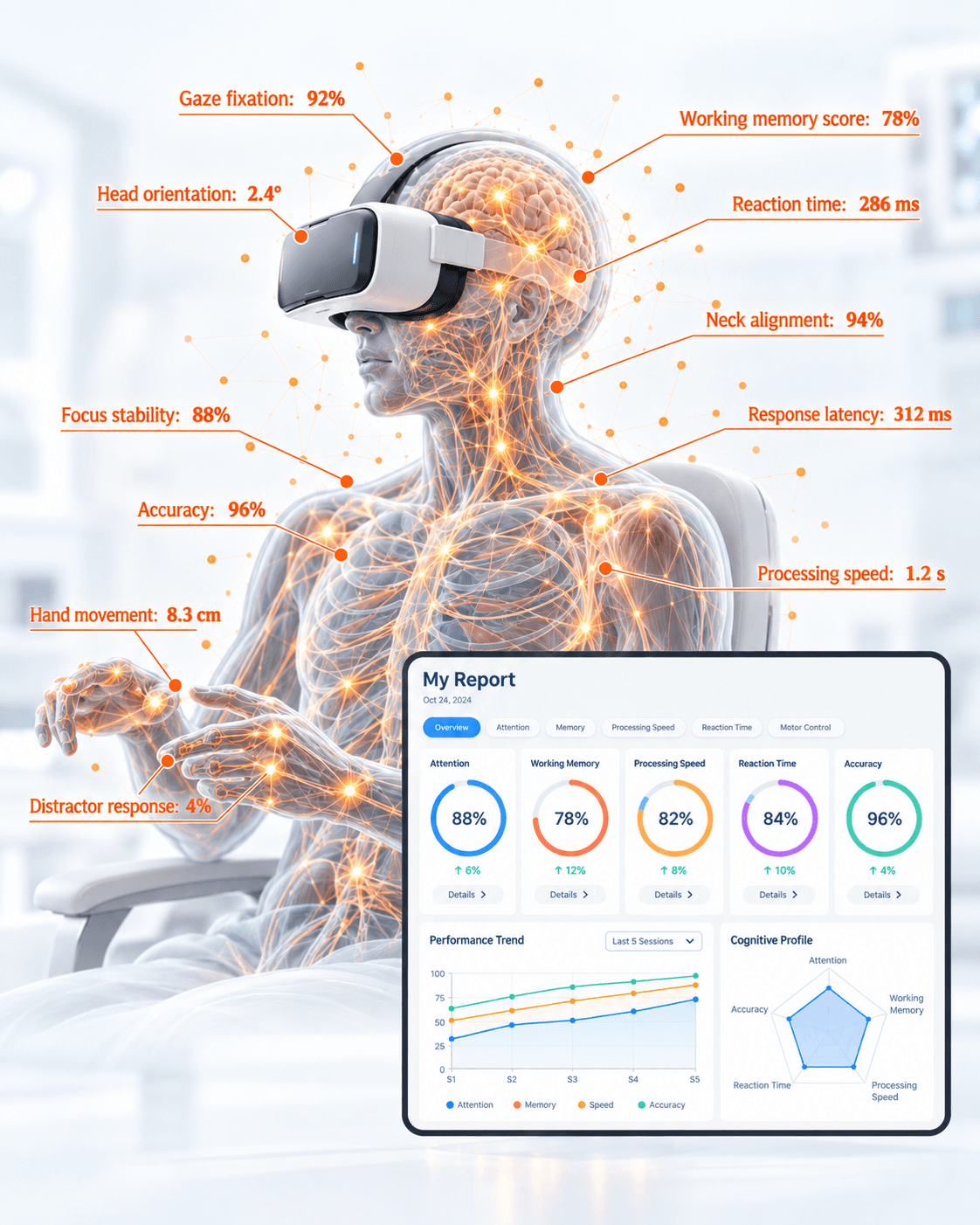
A person wearing a VR headset, drawn as a translucent figure with the nervous system lit up and the hands raised. Illustrative readings are labelled around them — gaze fixation 92%, head orientation 2.4 degrees, working memory score 78%, reaction time 286 milliseconds, neck alignment 94%, focus stability 88%, response latency 312 milliseconds, accuracy 96%, processing speed 1.2 seconds, hand movement 8.3 centimetres and distractor response 4% — beside a session report panel showing those scores as dials, a performance trend and a cognitive profile.
Readings shown are illustrative. APIScog is at MVP stage and has no validated measures.
cognitive domains
5
marker streams
3
in development
MVP

The experience

Real-world environments for cognitive wellbeing

APIScog is being developed around life-like VR environments that reflect everyday cognitive demands. Instead of abstract game-style tasks, the MVP begins with an airport-style scenario where users practise attention, working memory, processing speed, visual discrimination and impulse control in context.

The aim is to create cognitive training that feels natural, engaging and relevant for a broad range of users — from people who want to strengthen everyday cognition to future use cases in ageing, MCI, ADHD and cognitive rehabilitation.

  • Attention & Focus

    Target detection, sustained attention and distractor resistance

  • Working Memory

    Holding, updating and applying task rules

  • Processing Speed

    Fast, accurate decision-making under time pressure

  • Impulse Control

    Withholding or cancelling responses when the task changes

  • Visual Discrimination

    Identifying relevant targets among similar distractors

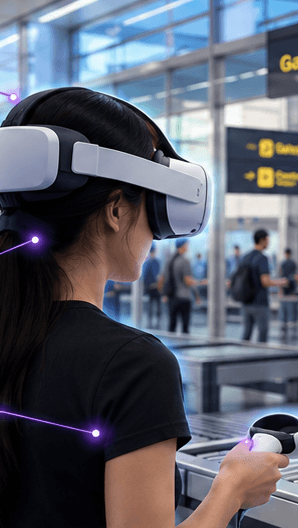
A person wearing a VR headset in an airport concourse, facing the departure gates signage with other travellers ahead of them.
  • Eye metrics

    • Gaze fixation
    • Scan patterns
    • Distractor dwell time
  • Head movement

    • Head orientation
    • Off-task movement
    • Return-to-task time
  • Hand / controller

    • Response initiation
    • Movement path
    • Hand stability

Task performance

  • Target item detected
  • Correct response

Response time 780 ms

Readings shown are illustrative. APIScog is at MVP stage and has no validated measures.

Platform capabilities

Built for cognitive wellbeing. Delivered in VR.

APIScog combines life-like VR environments, core cognitive training and exploratory digital markers in an MVP-stage platform designed to support cognitive wellbeing across age groups.

  • Ecologically Valid Environments

    APIScog is being developed around life-like VR environments that feel closer to everyday cognitive demands. Beginning with an airport-style scenario, the platform aims to make cognitive training more natural, immersive and meaningful than abstract game-based tasks.

    MVP focus: airport-based cognitive task environment

  • Core Cognitive Training

    APIScog is designed to support cognitive wellbeing by training key domains including attention, working memory, processing speed, visual discrimination and impulse control. The aim is to create engaging cognitive training that is relevant across age groups and everyday mental performance.

    Target domains: attention, memory, speed, discrimination and response control

  • Exploratory Digital Markers

    Beyond task performance, APIScog is being developed to explore candidate digital markers such as eye movement, head orientation and hand/controller movement. These may help us better understand engagement, distraction, reorientation and response style during immersive cognitive tasks.

    Candidate markers: gaze, head orientation and hand/controller behaviour

The system running

Tracking, as it is captured

A recording from the APIScog scene viewer: the tracked figure, the direction of its gaze, and the objects it is attending to as the task runs.

Scene viewer capture

This is development tooling rather than a product interface — it is how captured data is inspected, not what a user sees inside the headset.

How the platform works

The approach

Evidence-informed design for real-world impact

APIScog's methodology is grounded in well-established principles from cognitive neuroscience and VR research. Training within ecologically valid, real-life environments may engage wider neural networks and increase the likelihood of transfer to everyday life compared with abstract, game-based tasks.

  • Neuroplasticity

    Repeated, adaptive challenges may support brain network efficiency and cognitive resilience.

  • Ecological validity

    Life-like environments reflect everyday cognitive demands, making training more relevant and engaging.

  • Measurable outcomes

    Task performance and exploratory digital markers provide objective data on how users think, look and move during training.

Our path forward

Research-informed. Validation-led.

APIScog is currently at MVP stage. The platform is not yet clinically validated and is not intended to diagnose or treat any condition. The current focus is feasibility testing, usability, cognitive task design and exploratory digital marker development.

Research in VR rehabilitation suggests that life-like virtual environments can improve ecological validity and may increase the likelihood that skills and knowledge gained in VR transfer to the real world. APIScog is being built to test this principle within immersive cognitive training.

  1. 1

    Current stage

    MVP / prototype development

    • Develop VR environment
    • Refine cognitive tasks
    • Implement data capture (eye, head, hand)
  2. 2

    Next step

    Feasibility testing and pilot collaboration

    • User testing and usability
    • Preliminary data analysis
    • Explore real-world transfer
    • Collaborate with research and clinical partners
  3. 3

    Long-term aim

    Validated VR cognitive wellbeing platform with exploratory digital markers

    • Larger validation studies
    • Refine adaptive training
    • Explore diverse use cases (e.g. ageing, MCI, ADHD, healthy individuals)

Collaborate with us

Building the evidence base for VR cognitive wellbeing

APIScog is at the stage where pilot partners, researchers and investors shape what comes next. If that is you, we would like to hear from you.